Why leaders should be careful about their thoughts when they feel bad
“The more relaxed I am, the better I decide.”
That’s it.
This sentence should sound as obvious as saying that peas are small, round, and green.
Yet if it creates resistance or even slight irritation, it may be a sign that you are under influence.
Under the influence of what?
Stress. Pressure. A negative emotion.
When you are under influence, perception changes
Under tension, or under the influence of negative emotions — anger, sadness, worry, guilt — perception becomes distorted. You are no longer seeing the situation the way you would from a place of calm and clarity.
You may overestimate a risk, interpret an isolated issue as a deeper structural problem, suddenly doubt decisions that seemed perfectly sound the day before, or hear criticism in a neutral remark.
In short, your reading of reality becomes less reliable.
And the more responsibility you carry, the more costly this distortion can become.
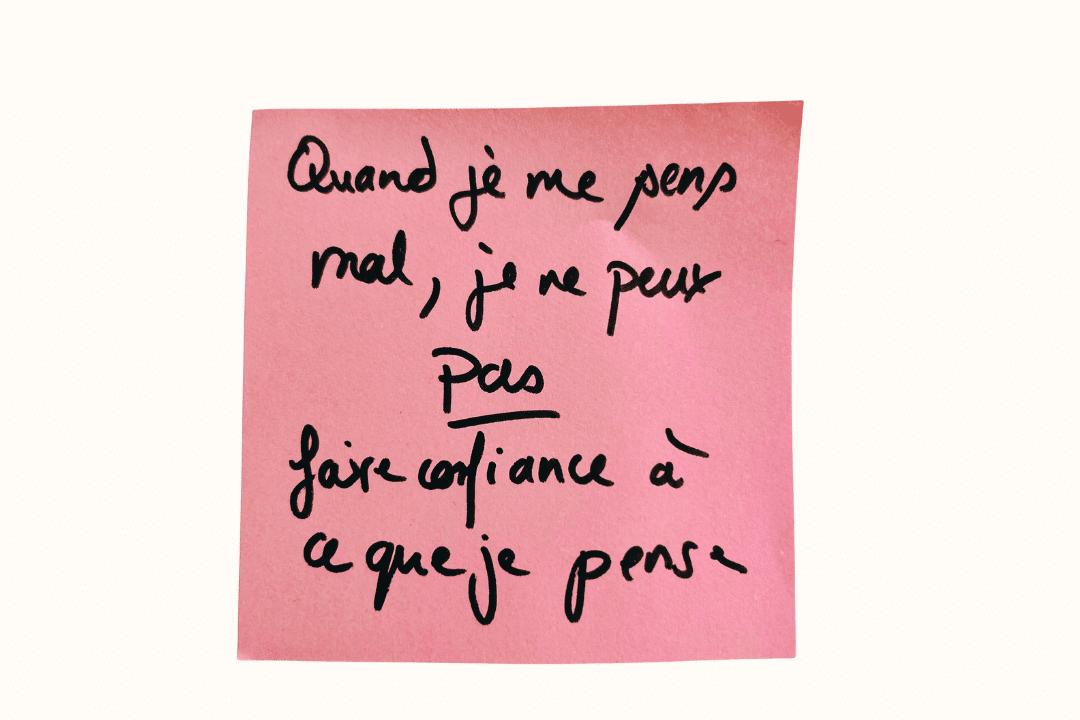
Which means that when you are under stress or strong negative emotion, you cannot fully trust what you think.
You might even want to carve this sentence into your desk:
When I feel bad, I cannot fully trust what I think.
(A sticky note works too.)
Deciding from stress or from clarity
Stress and negative emotions do not make you a bad leader. But making decisions from that state means deciding from a narrowed field of perception. And that narrowing is rarely neutral.
So what should you do?
The answer is less dramatic than a crisis strategy.
Start by relaxing.
Stress cannot survive in a relaxed body.
A relaxed body simply cannot hold on to stress.
Step 1: Relax
Release your shoulders.
Breathe.
Slow your breathing down, the way it naturally slows when you are about to fall asleep.
Step 2: Explore
Write down what you think about the situation that concerns you.
Identify the one sentence that bothers you the most.
- Is it factual or interpretative?
- Is it strategic or reactive?
- If you were perfectly calm and clear, would you still think the same thing?
- What would peace say?
Try it.
And observe what changes.
Stephanie Romeo
Executive Coach
Creator of the KAL™ Method
Host of the podcast 3 Minutes to Change Everything